
Suzan is a 3rd grade German Teacher who took advantage of Professional Growth and Development funding to attend the 2026 Northwest Math Conference in Portland, Oregon. She and a group of other GIS teachers attended a workshop on Building Thinking Classrooms in Mathematics by Peter Liljedahl. His research starts from the observation that traditional teaching norms, such as “I do, we do, you do” instruction, students working passively at desks, and pre-structured worksheets, often encourage “non-thinking” behavior, dependency on the teacher, and mimicry. The book outlines how to disrupt these habits and turn the math classroom into a place where students actively solve problems.
Suzan was inspired and excited to bring these ideas to her classroom, and she radically changed her practice. I met with her recently to learn more.
What it looks like in the classroom
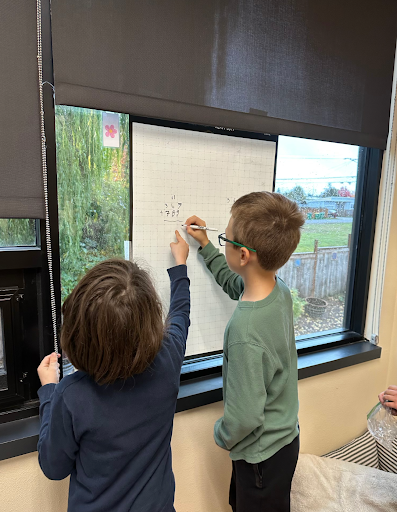
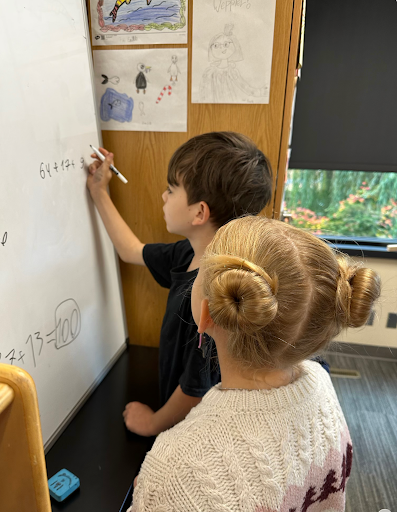
Students work in randomized groups: groups of three for older students, groups of two for younger ones. Randomizing matters because teachers who form groups themselves tend to configure them too intentionally.
The teacher presents a problem and keeps instruction brief, no more than three minutes. Then students head to the whiteboards, where the real work happens. Each group gets only one pen, so they have to talk to each other. Suzan noticed right away that erasable boards make students more willing to try, because nothing they write is permanent. The students also stand while they work. It took some getting used to, but now she and the kids love it. As they try an idea, talk it through, back up when it fails, and try a new approach, their engagement is more active and inspired. Meanwhile, Suzan circulates from group to group, so she always knows what each one is working on.
Suzan aims for open problems with a low floor and a high ceiling: not too easy, not too hard. As students work, she gradually increases the difficulty. Her third graders are currently working on multi-digit written addition. In one exercise, each group is given 500 points and a list of supplies to choose from. They must decide how to allocate their points to get the best combination of supplies.
When every group has finished, the class gathers to discuss. Suzan asks the students that were not in a particular group to explain that group’s thinking. What strategies did they use? Students speculate and build on one another’s ideas.
Students then continue by working on their own. They can choose between different difficulty levels rated as mild, medium, or spicy. They also assess their group work by placing themselves on a continuum, from “only one person doing most of the work” to “totally collaborative.” Suzan is transparent with students about the skills each addition lesson requires. Finally, each student sets a personal target and writes down what they want to remember.
Suzan has been to many conferences, but this one was different. “I’ve never changed my teaching 180 degrees. Completely. Once you see how much more engagement there can be created in the classroom you can’t unsee it. There is no passivity. Every child is active.”
When I asked what she’s noticed in her students, she said, “It’s wild!” They’ve developed impressive strategies. For example, they figured out on their own how to carry over: when the sum in the tens column exceeds ten, you carry the 1 to the hundreds column. When a student makes a connection like this, Suzan checks that everyone understands by asking them to explain it to one of the stuffed animals in the classroom. She’s been impressed by how clearly they can explain their thinking. The math isn’t memorized, she says. It’s intuited. “They understand it in a fundamental way that I haven’t seen before. It’s just incredible.”
Several teachers attended this workshop, and all are incorporating these strategies into their classrooms. Check in with Suzan, Franzi, Ava, or Kristina and ask them about their conference experience!
